
Why Your Parking System Doesn’t Understand the Academic Calendar
University Parking Management
How fixed-interval permit billing can reduce manual work across university parking programs.
At a university, parking rarely follows a simple monthly cycle.
As one term ends, another begins. Summer programs overlap with fall move-in. Medical students and research interns arrive on schedules that do not match the traditional semester. Visiting scholars may need parking for a defined appointment or grant period. Departments may manage groups with entirely different eligibility, billing, and access requirements.
Yet many permit systems still expect every parker to fit into a monthly or annual structure.
When the system and the academic calendar do not align, the parking office becomes the bridge between them—processing adjustments, tracking exceptions, reconciling access, answering questions, and maintaining side processes that compensate for what the software cannot do.
The Real Problem Is the Calendar Model
Many legacy permit systems treat the calendar month as the basic unit of parking. That may work when a program is simple. It becomes difficult when a university needs to support permit periods that do not begin on the first day of a month or end on the last.
To make those schedules fit, parking teams may have to:
- Combine monthly permits to approximate a semester or term
- Calculate partial-period charges, credits, or adjustments manually
- Create separate tracking for summer sessions, rotations, or special programs
- Reconcile permit, billing, and access changes across multiple systems
- Explain rules that make sense to the software but not to the parker
Each workaround may seem manageable by itself. Across multiple facilities, departments, and parker populations, the workload compounds quickly.
University Parking Runs on Overlapping Clocks
A university parking program may need to manage all of the following at the same time:
- Fall, spring, and summer academic terms
- Winter breaks and intersession periods
- Medical, clinical, and research rotations
- Visiting scholars, temporary appointments, and grant-funded programs
- Faculty sabbaticals and changing employment status
- Department-sponsored groups, contractors, and service providers
- Move-in, athletics, camps, events, and other seasonal programs
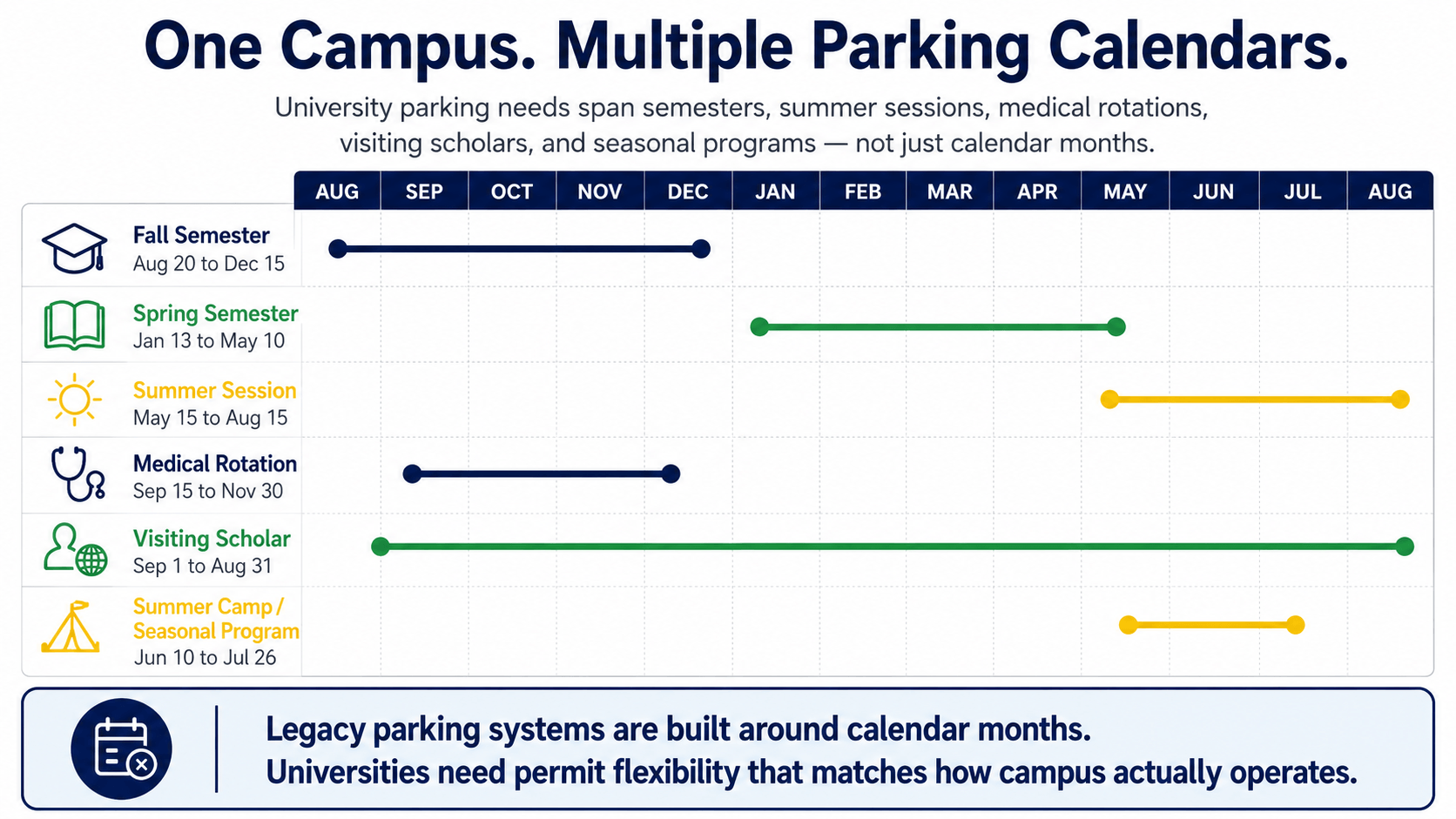
The university thinks in programs, terms, and defined periods. The permit system may still think in months.
That mismatch affects more than convenience. It can influence billing accuracy, account status, access permissions, reporting, and the amount of staff time required to keep everything aligned.
What Fixed-Interval Permit Management Changes
Modern permit platforms can support defined start and end periods as a core configuration rather than treating every non-monthly request as an exception.
Instead of asking, “Which monthly permit should we force this person into?” the parking team can ask, “What permit period does this parker population actually need?”
That approach can support:
- Semester- or term-based permit windows
- Summer and seasonal program permits
- Annual and recurring permit programs
- Defined periods for specific parker populations
- Billing schedules aligned with configured permit periods
Zephire supports fixed-interval permit billing with defined start and end periods, including semester-based, term-based, seasonal, and other configured permit windows. The goal is not to eliminate university policy decisions. It is to give parking teams a system capable of executing those decisions more consistently.
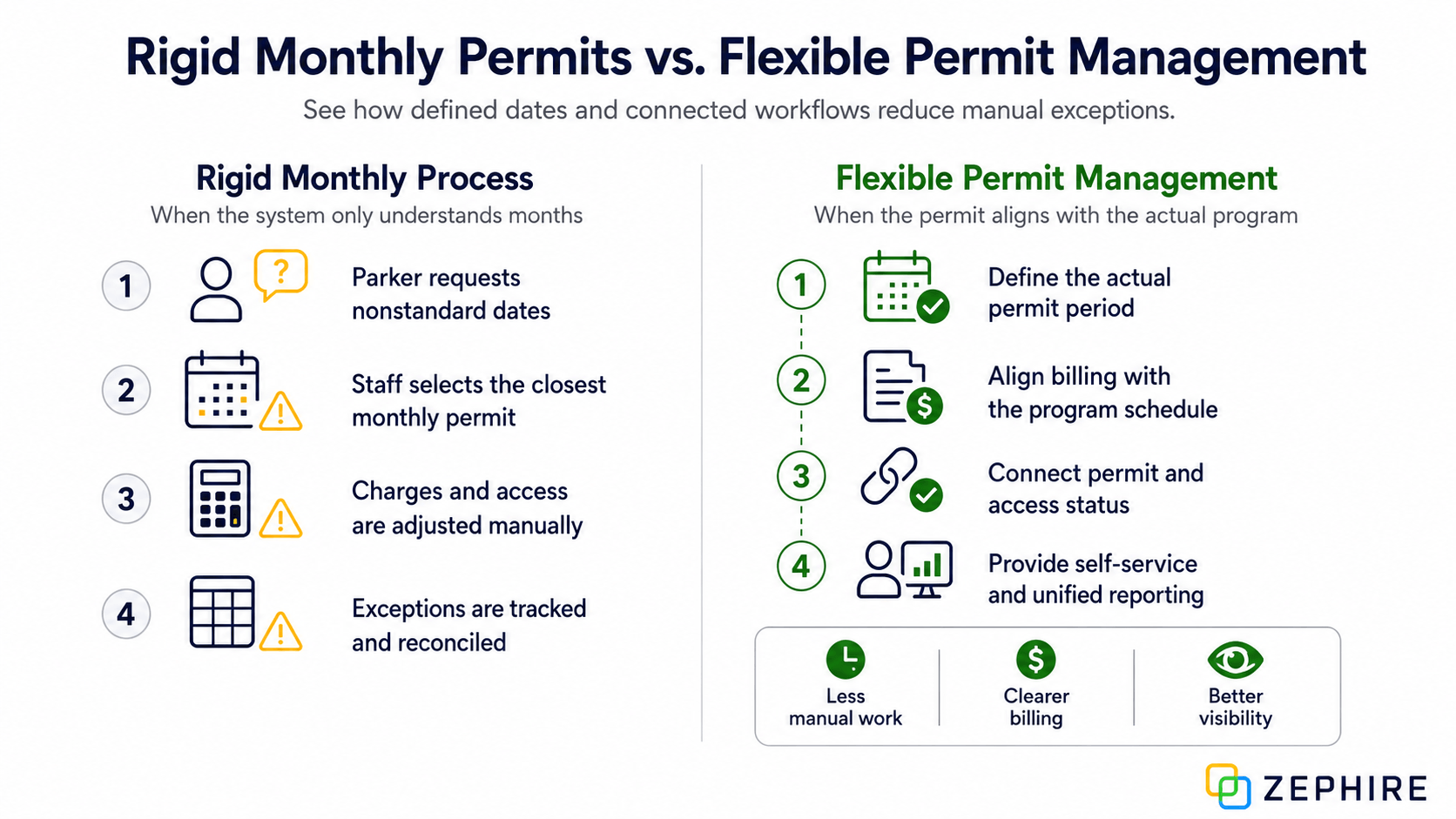
What Flexibility Looks Like in Practice
1. Semester-Aligned Permits
A fall permit can be configured around the institution’s actual fall term—for example, August 20 through December 15—rather than being approximated through four or five separate monthly periods. The same structure can be used for spring or other academic terms.
2. Summer and Special Programs
A university can define a summer permit window that matches its summer session, camp, or seasonal employment period. Parking staff do not have to rely on recurring manual credits or one-off spreadsheets simply because the program starts or ends mid-month.
3. Visiting Scholars and Department Groups
Universities often need to support temporary scholars, postdoctoral researchers, contractors, and department-sponsored parkers alongside full-time faculty and staff. Defined permit periods and group or contract account structures help the parking office manage those relationships while maintaining centralized visibility and control.
The Operational Impact Goes Beyond Convenience
Less Exception Work
When permit periods can be configured around the institution’s operating reality, staff spend less time translating academic dates into monthly workarounds and correcting the issues those workarounds create.
Clearer Billing and Account Status
Defined permit and billing periods create a cleaner framework for understanding what a parker purchased, when the permit is active, and how the account should be handled.
Better Alignment with Access Workflows
Connected permit and access workflows can reduce the amount of manual reconciliation required when a permit begins, expires, changes, or is suspended.
More Useful Reporting
When records reflect actual terms, permit types, locations, and parker groups, reporting becomes more meaningful. Leadership can evaluate demand and activity based on the way the university operates—not just on arbitrary monthly buckets.
A Better Parker Experience
Students, faculty, staff, and campus partners are more likely to understand a permit that matches a familiar academic or program period. Self-service account tools can also reduce routine requests while giving parkers more control over common account needs.
Seven Questions to Ask About Your Current System
A useful evaluation starts with the work your team performs today. Ask:
- Can we configure semester, term, seasonal, or other defined permit periods without manual workarounds?
- Can billing schedules follow those permit periods?
- Can we manage individual, department, group, and contract relationships in one operating system?
- Can parkers complete common account updates through self-service tools?
- Are permit, billing, and access statuses connected closely enough to reduce reconciliation?
- Can leadership report by term, permit type, location, and parker group?
- How many staff hours are currently spent managing exceptions that the system cannot handle natively?
If several of those questions expose gaps, the issue may not be that your team needs to work harder. The system may be asking the team to compensate for a structure that no longer fits the university.
Where Zephire Fits
Zephire is designed to connect the workflows involved in monthly and permit-based parking. For university programs, relevant capabilities include fixed-interval permit billing with defined start and end periods, parker self-service, group and contract account tracking, dashboards and reporting, and PARCS or access-system integrations.
The objective is not to force every university into the same parking model. It is to give the parking team a flexible operating structure that can reflect the institution’s rules, parker populations, and academic calendar with less manual translation.
The Bottom Line
Your academic calendar should be an input to your parking system—not a source of exceptions.
When the software reflects the way the university already operates, parking staff can spend less time maintaining workarounds and more time improving service, visibility, utilization, and long-term planning.
Planning to Modernize Permit Management?
Download the University Parking Leader’s Implementation Guide for a practical framework covering assessment, configuration, data migration, testing, launch, and optimization.
Download the Guide